
Get our weekly roundup of smart savings tips.



Medicare Parts A, B, C, and D, explained simply
What Medicare Parts A, B, C, and D really cover, what they cost in 2026, and how to choose the right combination. Plain English, no jargon.
Medicare Parts A, B, C, and D, explained simply
A plain-English breakdown of what each part of Medicare actually covers, what it costs in 2026, and which combinations make sense for most people in their 50s and 60s.
If you ask ten people what the letters in Medicare stand for, eight of them will guess. The other two will be wrong on purpose. The system is not complicated on paper, but the marketing around it makes it sound like a Rubik's Cube. So let's strip the marketing away.
Medicare has four parts. Each part covers a different slice of your health care. You don't pick one. You stack them, and the way you stack them decides what you'll pay and which doctors you can see.
Here's the whole thing in under 200 words, then we'll go deeper on each part with the real 2026 numbers.
The 30-second version
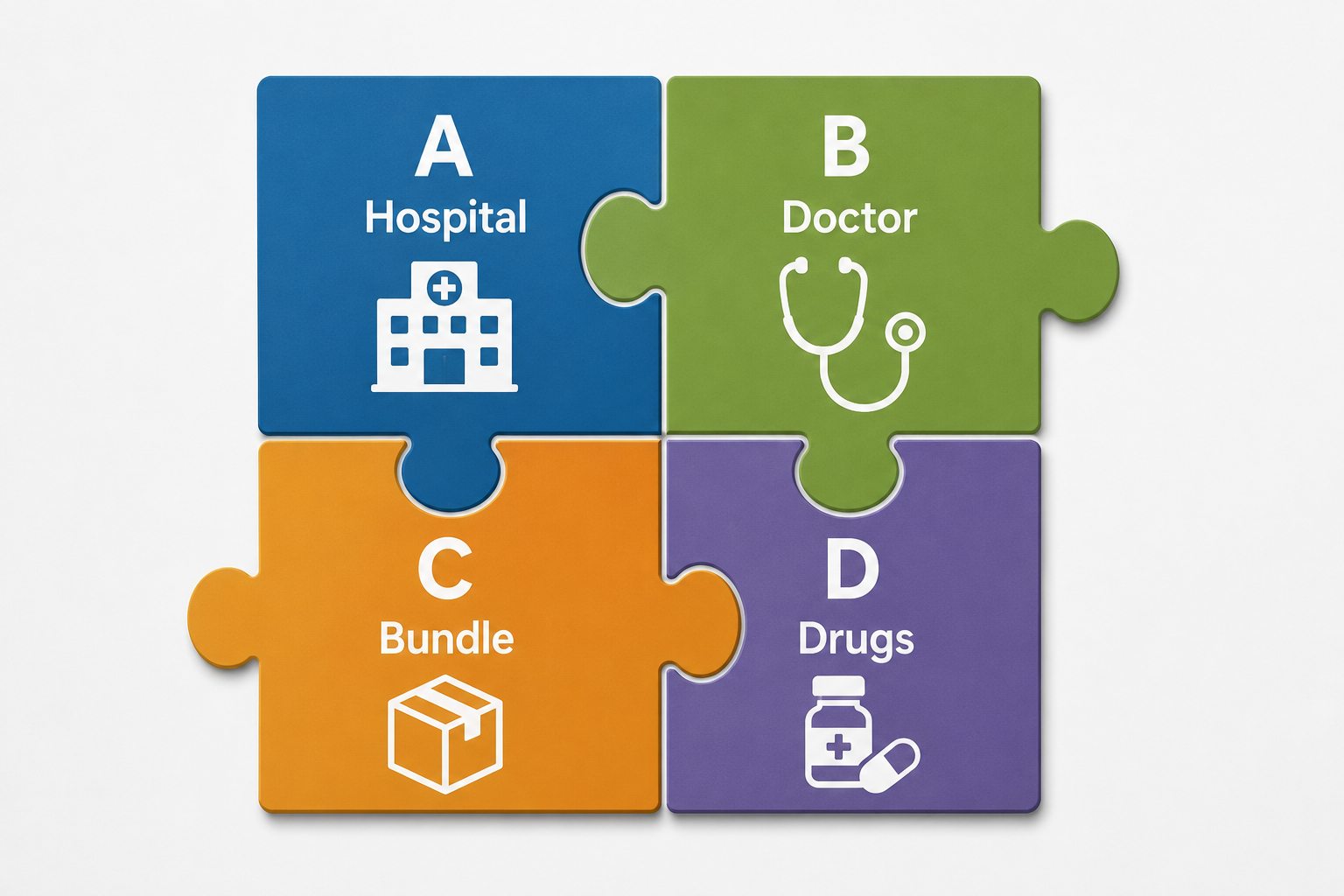
Part A pays for the hospital. Part B pays for the doctor. Part C is a private bundle that replaces A and B with one card. Part D pays for prescription drugs.
Most people are eligible at 65. If you've worked at least 10 years, Part A is free. Part B has a monthly premium. Part C and Part D are sold by private insurers.
That's it. Now let's get into what each one actually does.
Part A: Hospital insurance
Part A is the one most people think of when they think of Medicare. It pays for inpatient hospital stays, skilled nursing facility care after a hospital stay, hospice, and some home health care.
If you or your spouse paid Medicare payroll taxes for at least 10 years, Part A has no monthly premium. The catch is the deductible. In 2026 it's $1,736 per benefit period, up $60 from 2025.1
A benefit period starts the day you check in to a hospital and ends 60 days after you leave. If you go back in within those 60 days, you don't pay the deductible again. If you go back in on day 61, you do.
After day 60 in the hospital, daily coinsurance kicks in. The exact dollar figures matter less than the principle: Part A handles the big stuff, but it doesn't cover everything, and the gaps can get expensive.
Part B: Doctor and outpatient care
Part B is the part that pays the doctor. It covers office visits, lab work, preventive screenings, durable medical equipment, ambulance rides, and most outpatient procedures.
Part B has a monthly premium that almost everyone pays. The standard premium for 2026 is $202.90 a month, up from $185.00 in 2025.2 That's a 9.7 percent jump, the biggest single-year increase in a while. If your income is above certain thresholds, you'll pay more under what's called IRMAA, which can push the monthly cost over $600.
Part B also has an annual deductible. In 2026 it's $283.2 After you meet it, Medicare typically pays 80 percent of approved charges. You pay 20 percent. There is no cap on that 20 percent, which is one reason most people buy supplemental coverage.
Part C: Medicare Advantage, the all-in-one bundle
Part C is also called Medicare Advantage. Private insurance companies bundle Parts A, B, and usually D into a single plan. You still pay your Part B premium, but the insurance company collects the rest and runs the show.
Advantage plans usually have lower monthly costs and often throw in extras like dental, vision, hearing aids, or a gym membership. The tradeoff is that you're locked into a network. You can only see in-network doctors, and if you travel a lot or split time between two states, that can get awkward.
Advantage plans also require prior authorization for a lot of services. That means before your specialist can order a test or schedule a procedure, the insurance company has to sign off. If they don't, you're stuck appealing or paying out of pocket.
Part D: Prescription drugs
Part D is the prescription drug benefit. Sold by private insurers. You sign up separately if you have Original Medicare, or it's built in if you have most Advantage plans.
Average base premium for standard Part D coverage in 2026 is about $38.99 a month, up from $36.78 in 2025.3 Premiums vary widely by plan, and the cheapest one isn't always the best. What matters is whether your specific drugs are on the plan's formulary and what tier they sit on.
Starting in 2025, the Inflation Reduction Act capped out-of-pocket Part D drug costs at $2,000 per year. That cap continues in 2026 with inflation adjustment. For anyone on expensive maintenance medications, that's the most meaningful change to Medicare in a decade.
How most people put it together
Two paths cover the majority of people:
Path 1: Original Medicare plus a Medigap policy plus a Part D plan. You get the broadest doctor network in the country. You can see any provider that takes Medicare. The downside is that you're paying three premiums.
Path 2: Medicare Advantage. One card, one premium, often zero on top of Part B. The network is narrower but the out-of-pocket costs are usually lower for healthy years.
Which path fits depends on three things. How often do you travel. Whether you have specialists you can't lose. How much risk you're willing to carry on a really bad year. Answer those three, and the choice usually answers itself.
What to do next
If you're turning 65 in the next six months, sign up for Part A and B at Medicare.gov during your initial enrollment period, which runs three months before your birth month through three months after. Missing that window can mean lifetime late penalties.
Run your specific prescriptions through the Plan Finder tool at Medicare.gov to see which Part D plan actually saves you the most. Don't pick on premium alone.
If you're already on Medicare, mark October 15 to December 7 on your calendar. That's the annual open enrollment window when you can change plans for the following year.
Sources
1. Center for Medicare Advocacy, 2026 Medicare Parts A & B Premiums and Deductibles, November 2025. medicareadvocacy.org/2026-medicare-rates
2. U.S. Railroad Retirement Board, Medicare Part B Premiums and Deductibles Will Increase in 2026, November 2025. rrb.gov/Newsroom/NewsReleases/MedicarePartBPremium
3. Segal, Medicare Part B Premiums Rise for Retiree Health Plans, November 2025. segalco.com

Get our weekly roundup of smart savings tips.